
Written by ZufishanMS Environmental ScienceLast reviewed
What is a cumulative GPA?
A cumulative GPA is a credit-weighted average of every grade you have earned in your academic career. In the United States it is reported on a 0.0 to 4.0 scale. It differs from a semester GPA, which covers only one term. Your cumulative GPA is the number that appears at the bottom of your transcript and the one most institutions reference for academic standing.
Why credit weighting matters
Credit hours measure how much of your overall workload a course represents. A 4-credit physics course with a lab counts for twice as much as a 2-credit elective. The calculator multiplies each course's grade points by its credit hours, adds the totals, and divides by the total credit hours. This is the same method your registrar uses.
How is cumulative GPA calculated?
Multiply each course's credit hours by its grade points, add those products across all courses, then divide by the total credit hours.
Formula: Cumulative GPA = Σ(Credit Hours × Grade Points) ÷ Σ(Credit Hours)
Step-by-step example: calculating cumulative GPA
One way to find a cumulative GPA is to combine the GPA from each semester with that semester's credit load:
| Semester | Credits | Semester GPA | Quality points |
|---|---|---|---|
| Year 1 | 30 | 3.2 | 96.0 |
| Year 2 | 30 | 3.6 | 108.0 |
| Year 3 | 28 | 3.8 | 106.4 |
| Total | 88 | 310.4 |
Cumulative GPA = 310.4 ÷ 88 = 3.53. The calculator above does the same thing course by course, so you can enter every class from your transcript and get the same figure.
Reading your cumulative GPA result
The calculator colour-codes your cumulative GPA so you can see your standing at a glance:
| GPA | Colour | Standing |
|---|---|---|
| Below 2.0 | Red | Below good academic standing at most schools |
| 2.0 to 2.99 | Amber | Good standing, below most graduate-school floors |
| 3.0 to 3.49 | Blue | Meets common graduate and scholarship minimums |
| 3.5 and above | Green | Dean's list and honours territory |
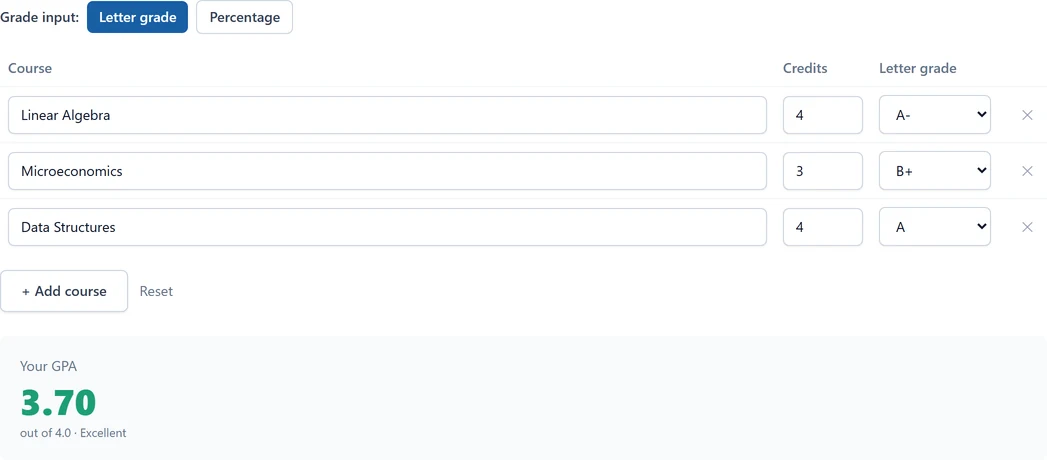
How to calculate cumulative GPA with this calculator
- Open your transcript or unofficial grade report.
- Choose letter grade or percentage input mode.
- Add a row for every course, then enter its credit hours and grade.
- Click + Add course as many times as you need. There is no limit.
- Read your cumulative GPA at the bottom of the calculator.
When to use the Cumulative GPA Calculator
Use it when you are applying to graduate school or transferring, since those applications ask for your cumulative GPA rather than a single semester. Use it for planning by adding hypothetical grades for your next term to see how they would move your overall average. If your transcript is on a different scale, convert it first with the CGPA to Percentage tool or the CGPA to GPA converter, then enter the results here.
Cumulative GPA targets to know
These benchmarks apply at most US universities:
| GPA | What it typically unlocks |
|---|---|
| 2.0 | Minimum for good academic standing |
| 3.0 | Common floor for graduate applications and scholarships |
| 3.5 | Typical dean's list or honours threshold |
| 3.7 and above | Competitive for top graduate schools and merit awards |
Common mistakes when calculating cumulative GPA
Leaving out completed courses. A cumulative GPA needs every credit-bearing course on your transcript. Skipping a few will give you a semester-style average rather than a true cumulative figure.
Including pass or fail courses. These usually carry credit hours but no grade points. Adding them with a made-up grade distorts the result. Leave them out unless your school counts them.
Guessing at credit hours. Use the credit value printed on your transcript, not the number of weekly class meetings. A course that meets four times a week can still be worth three credits.
Mixing grading scales. This calculator uses the US 4.0 scale. If some of your courses are on a 10.0 scale, convert them with the CGPA to GPA converter before entering them.
Cumulative GPA vs CGPA in India and Pakistan
In India and Pakistan, CGPA can refer to a 4.0, 5.0, or 10.0 scale depending on the institution. If your transcript uses one of those scales, convert it to a percentage with the CGPA to Percentage tool or to a US 4.0 GPA with the CGPA to GPA converter, then enter the converted values in this calculator.
Related calculators
- GPA Calculator for a single semester GPA
- Weighted & Unweighted GPA Calculator if your school adds points for honors or AP/IB classes
- Target GPA Calculator for the GPA you need next term to reach a goal
- CGPA to GPA for converting a 10.0 or 5.0 CGPA to the 4.0 scale
- CGPA to Percentage for converting CGPA into a percentage
- Grade Calculator for a single course grade from components
Disclaimer: Results are educational estimates based on the US 4.0 scale and the grades you enter. Your institution may use a different scale, rounding rule, or transfer-credit policy. Always confirm your official cumulative GPA with your registrar before relying on it for applications.