
CBSE Grading System Explained: 10-Point Scale 2026
How the CBSE grading system works for class 10: the 9-point letter grades from A1 to E2, what marks each grade covers, and the official CGPA × 9.5 percentage conversion.
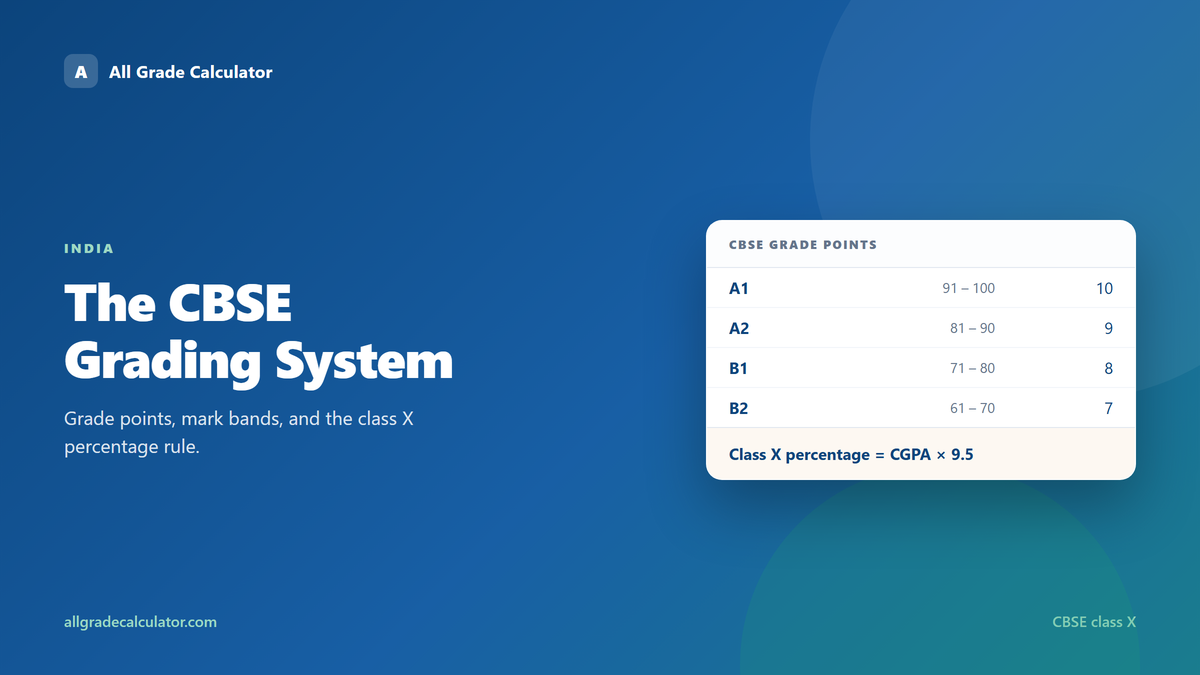
The CBSE grading system turns a subject's marks into one of nine letter grades, from A1 at 91-100 marks down to E2, and each grade carries a grade point on a 10-point scale. Averaging those grade points gives the CGPA, and CBSE's own circular converts a CGPA to a percentage by multiplying it by 9.5.
Quick answers
- The scale: nine grades, A1 to E2. A1 is 91-100 marks and carries 10 grade points.
- Passing: A1 through D are passing grades. D covers 33-40 marks. E1 and E2 mean you re-appear.
- Percentage: CGPA × 9.5, from CBSE Circular No. 24 of 28 May 2010, which calls it indicative.
- Class 10 today: results show marks. The CGPA appeared on class 10 results from the grading years.
- Class 12: marks only. The grading scheme never covered it, so there is no CGPA to convert.
CBSE, the Central Board of Secondary Education, is India's largest school board, with affiliated schools across India and abroad. It introduced grading for classes 9 and 10 from the 2009-10 academic year, so class 10 results from 2010 showed grades and a CGPA, and later returned to numerical marks. This guide covers the system as it stands in 2026.
The CBSE grading system at a glance
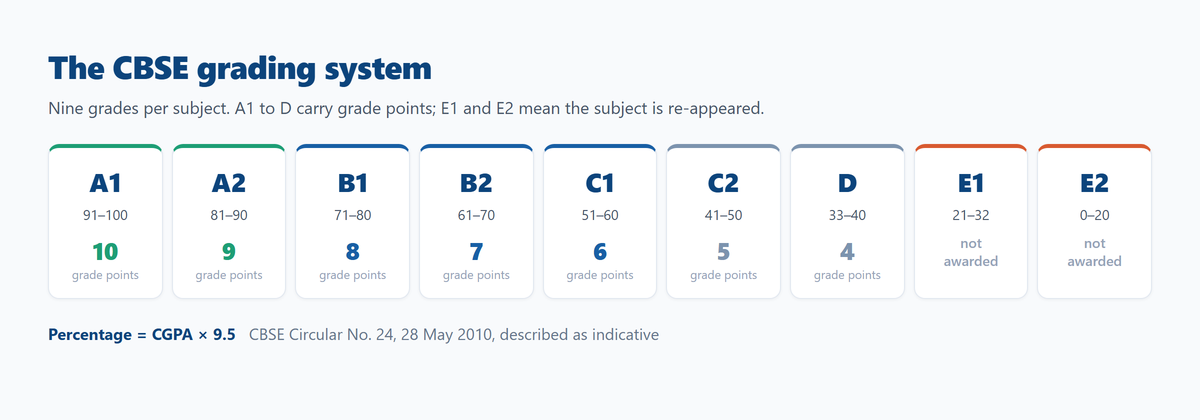
CBSE 9-point letter grade scale
| Grade | Grade points | Marks range |
|---|---|---|
| A1 | 10 | 91–100 |
| A2 | 9 | 81–90 |
| B1 | 8 | 71–80 |
| B2 | 7 | 61–70 |
| C1 | 6 | 51–60 |
| C2 | 5 | 41–50 |
| D | 4 | 33–40 |
| E1 | not awarded | 21–32 |
| E2 | not awarded | 0–20 |
A1 through D are passing grades. E1 and E2 mean the candidate must re-appear in that subject, which is why neither carries grade points. The grade points are what the CGPA conversion below works from.
What grade is my mark?
Read the table from the bottom of your band, not the top. A mark of 91 is an A1, and so is a mark of 100: the grade is the same across the whole band, which is why two students with an A1 can be nine marks apart. That flattening is the point of grading, and it is also why a CGPA converted back to a percentage is only ever indicative.
The official CBSE CGPA formula
Percentage = CGPA × 9.5
CBSE gave this as an "indicative" equivalence in Circular No. 24 of 28 May 2010 ("Overall indicative percentage of marks = 9.5 x CGPA"). The circular does not explain how 9.5 was chosen. CBSE does not calculate a percentage itself: its notice of 30 November 2023 leaves that to the admitting institution or employer.
Use the CBSE CGPA to percentage calculator on allgradecalculator.com for instant conversion.
Worked examples
- CGPA 9.6 → 9.6 × 9.5 = 91.2 %
- CGPA 8.4 → 8.4 × 9.5 = 79.8 %
- CGPA 7.2 → 7.2 × 9.5 = 68.4 %
- CGPA 6.0 → 6.0 × 9.5 = 57.0 %
Per-subject CGPA
CBSE awards a grade and grade point per subject as well as a cumulative CGPA. Multiply each subject's grade point by 9.5 to get an indicative percentage for that subject. Keep in mind that CBSE itself describes this as an indicative number. The official record is the letter grade.
Class 10 versus class 12
- Class 10. CBSE's grading scheme covered classes 9 and 10 (Circular No. 24/2010), and class 10 results from 2010 showed a CGPA. Transcripts from the grading years need conversion; later results show marks.
- Class 12. The grading scheme did not cover class 12, so class 12 results are in marks and no CGPA conversion is needed. If a form asks a class 12 candidate for a CGPA, the percentage on the mark sheet is what to give.
Why the conversion matters
A surprising number of admission portals, including state engineering counselling, private universities and overseas applications, still ask for a percentage even when the candidate's CBSE class 10 result is on the CGPA scale. Using an unofficial conversion, multiplying by 10 instead of 9.5 for example, systematically over-states the percentage and can be flagged during verification.
CBSE grading versus ICSE
ICSE (CISCE) issues marks directly for both class 10 and class 12, so the CGPA × 9.5 formula does not apply to ICSE. If your transcript is from CISCE rather than CBSE, use the percentage as printed.
CBSE and the rest of India
State boards in India typically issue marks rather than CGPA, but a small number have moved to CGPA-style grading. Each board has its own formula, so check the back of your mark sheet or the board's regulations. Most universities accept marks directly and need no conversion at all.
Tips for CBSE class 10 students
- Know your formula. If you sat class 10 in the grading years, your transcript shows a CGPA, and applying for class 11 or competitive exams may require a percentage.
- Don't round. Always cite the exact CGPA × 9.5 number on applications, not a rounded version.
- Improve subject by subject. Compartment and improvement exams let you re-take a subject, and the replacement grade replaces the original.
Frequently asked questions
What is the CBSE grading system?
A nine-point letter scale applied per subject: A1 for 91-100 marks, A2 for 81-90, B1 for 71-80, B2 for 61-70, C1 for 51-60, C2 for 41-50, D for 33-40, then E1 and E2 below that. A1 down to D carry grade points from 10 to 4, and the average of those points is the CGPA.
Is CBSE class 10 graded or marked now?
Class 10 results show marks. The CGPA and letter grades appeared on class 10 results from the grading years that began with the 2009-10 session. If your mark sheet is from those years it carries a CGPA; a later one carries marks.
What is the A1 grade in CBSE?
The highest grade, awarded for 91 to 100 marks in a subject, and worth 10 grade points. A student scoring 91 and a student scoring 100 both receive an A1.
What is the passing grade in CBSE?
D is the lowest passing grade and covers 33 to 40 marks. E1 (21-32) and E2 (0-20) are not passing grades: the candidate re-appears in that subject, and neither grade carries grade points.
How do I convert a CBSE CGPA to a percentage?
Multiply the CGPA by 9.5, which is the equivalence CBSE published in Circular No. 24 of 28 May 2010 and described as indicative. A CGPA of 8.4 becomes 79.8%. Do not multiply by 10, which over-states the result and can be flagged during verification.
Does CBSE class 12 use CGPA?
No. The grading scheme covered classes 9 and 10 only, so class 12 results are reported in marks. There is no class 12 CGPA to convert.